Psychiatric Service Dogs vs Emotional Support Animals in Oklahoma
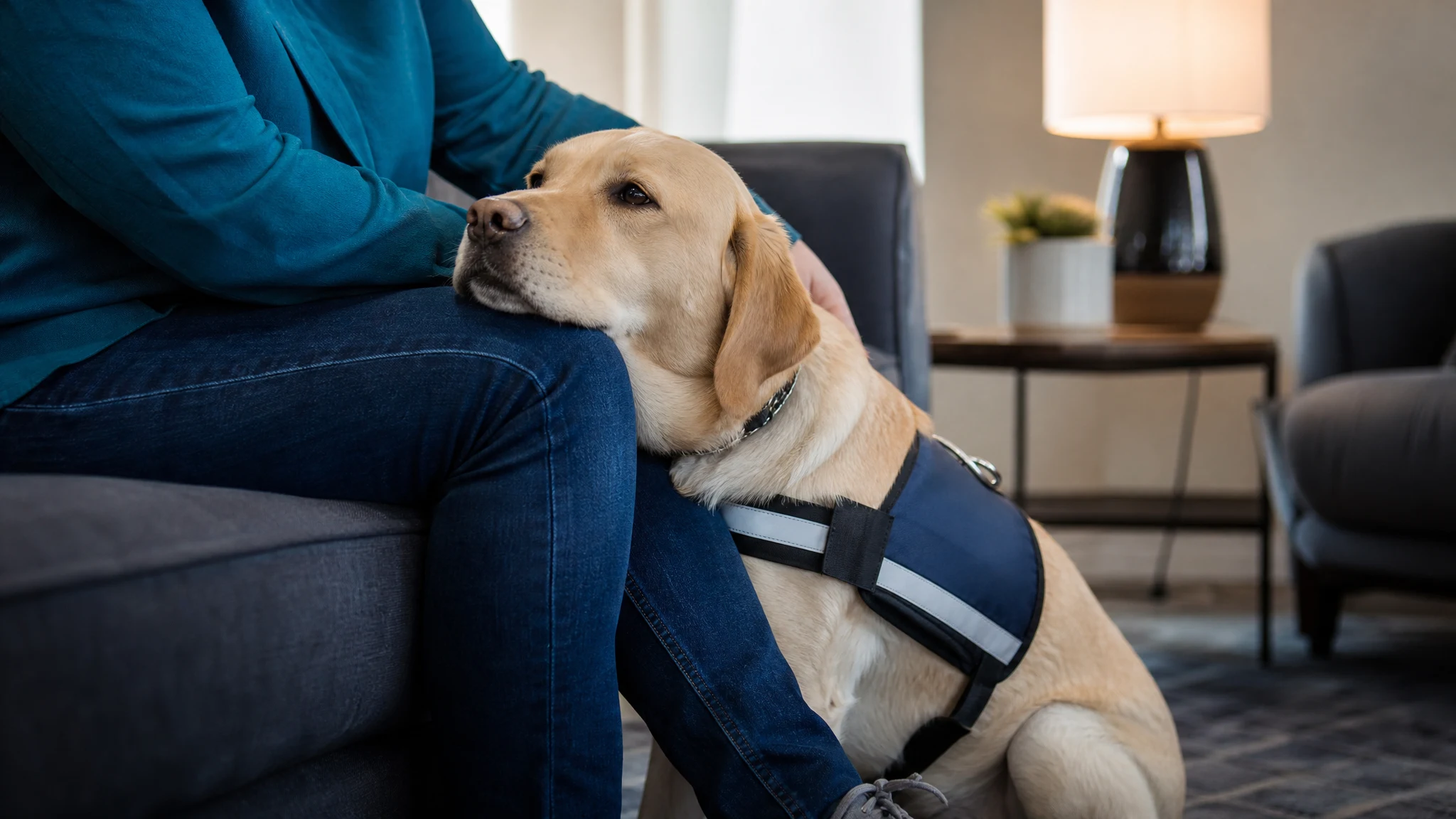
This page explains the law in general terms. It is not legal advice. For a specific situation, contact the agency listed on this site or an attorney.
People often use the two terms as if they mean the same thing. In the law they do not. A psychiatric service dog and an emotional support animal can both bring real comfort. They are treated very differently in stores, restaurants, rental housing and airports.
This guide explains the service dog vs emotional support animal question in plain terms. It covers the federal rules, what Oklahoma statutes say, and which option fits which situation. It is general information, not legal advice.
The short version
- A psychiatric service dog is a dog individually trained to do work or tasks for a person with a disability. It has public access rights under the ADA.
- An emotional support animal (ESA) provides comfort by being present. It is not trained to perform a specific task, so it is not a service animal under the ADA.
- Housing is a different story. Both can come up in a housing request, under different rules.
What the ADA says
ADA.gov defines a service animal as a dog that has been individually trained to do work or perform tasks for an individual with a disability. That wording covers psychiatric disabilities as well as physical, sensory and intellectual ones. The dog's work must be directly related to the person's disability.
Emotional support, therapy and comfort animals do not meet that definition. The dividing line is task training, not the diagnosis and not the kind of paperwork someone holds.
Examples of psychiatric tasks include interrupting harmful repetitive behavior, providing pressure during a panic episode, or waking a person from nightmares. A dog that calms someone simply by being nearby is giving comfort, which is what an ESA does.
The two questions staff may ask
When the disability or the dog's role is not obvious, ADA.gov says staff may ask only two things:
- Is the dog a service animal required because of a disability?
- What work or task has the dog been trained to perform?
Staff cannot demand paperwork or a demonstration of the task. There is no official service dog registry or required certification under the ADA. Online registrations, ID cards and certificates are not legal proof of anything, and no one has to buy one.
Oklahoma law
Oklahoma has its own statutes on top of the ADA. The sources below are the Animal Legal and Historical Center at Michigan State University College of Law, which compiles these laws, and the Oklahoma House of Representatives.
- Public access, 7 O.S. 19.1. Under the compilation, a blind, physically handicapped, deaf or hard-of-hearing person with a guide, signal or service dog may not be denied access to the listed public places because of the dog. The dog may ride common carriers without an added charge. The handler is liable for damage the dog does to the premises. A dog used by a deaf or hard-of-hearing person must wear an orange identifying collar. Violating this section is a misdemeanor under 7 O.S. 19.2.
- Harming or interfering, 21 O.S. 649.3. This section covers harming or interfering with service animals. It defines a service animal broadly, as an animal trained to guide or assist a person with a sensory, mental or physical impairment.
- Housing, 25 O.S. 1452. Subsection (A)(13) makes it unlawful to refuse to rent or lease housing to a blind, deaf or disabled person because of a bona fide, properly trained guide, signal or service dog.
- Misrepresentation, HB 1178 (2025). The Oklahoma House says this law makes it a misdemeanor to pass off a non-service animal as a service animal. It took effect Nov. 1, 2025, after a veto override. Check the enacted text or the Attorney General for fines and exact wording.
One point matters for psychiatric service dog handlers in Oklahoma. The public access wording in 7 O.S. 19.1, as compiled, speaks of physical, hearing and sight disabilities. Handlers with psychiatric disabilities should treat the ADA as the main source of their public access rights. For the exact statute wording, read the official Oklahoma statutes or ask the agency listed at the end of this page.
Housing: the Fair Housing Act
Housing is where the two categories overlap most. The Fair Housing Act, enforced by HUD, covers assistance animals in housing, and that category is broader than the ADA's service dog definition. A landlord may have to consider a reasonable accommodation request for an animal that provides emotional support, even though that animal has no public access rights. A psychiatric service dog is also covered.
HUD sets the details, including what documentation a housing provider may ask for. Those details change, so confirm the current guidance with HUD before relying on any summary, including this one. Oklahoma's 25 O.S. 1452(A)(13) adds a state rule against refusing to rent because of a bona fide, properly trained service dog. The compilation also lists a bar on extra nonrefundable fees or unreasonable deposits, with the tenant liable for damage.
Air travel: the DOT 2020 rule
Air travel changed in 2020. Under the U.S. Department of Transportation's Air Carrier Access Act rule, airlines are no longer required to treat emotional support animals as service animals. The DOT rule uses a definition close to the ADA's: a dog individually trained to do work or perform tasks for a person with a disability, including a psychiatric one. An ESA is treated as a pet and follows the airline's pet policy.
Airlines may ask service dog users to submit DOT forms before travel. Requirements vary by airline, so check with DOT and your carrier well before your flight.
Side-by-side comparison
| Attribute | Psychiatric service dog | Emotional support animal |
|---|---|---|
| ADA status | Service animal if it is a dog individually trained to do work or tasks for a person with a disability (ADA.gov) | Not a service animal under the ADA |
| Task training | Required, tied to the disability | Not required; comfort comes from presence |
| Species | Dogs under the ADA | Varies by housing rules |
| Public access (stores, restaurants) | Yes, under the ADA | No ADA right; each business sets its own pet policy |
| Housing | Covered by the Fair Housing Act and 25 O.S. 1452(A)(13) | May be considered as a reasonable accommodation under the Fair Housing Act; check HUD guidance |
| Air travel | Recognized under the DOT 2020 rule, with airline forms | Treated as a pet by airlines |
| Registration or certification | None required under the ADA | None that grants public access |
| Oklahoma misrepresentation law | Handler must have a true service animal (HB 1178) | Must not be passed off as a service animal |
Pros and cons
Psychiatric service dog
Pros
- Public access rights under the ADA in places where pets are not allowed.
- Trained tasks give predictable help during symptoms.
- Recognized in housing and air travel rules.
Cons
- Training takes a lot of time. A dog must be trained to do tasks and to behave well in public.
- Not every dog is suited to the work.
- Program waitlists can be long. Therapetics Service Dogs of Oklahoma in Tulsa says its wait is between 2 and 3 years or more.
- The handler is responsible for the dog's control, care and any damage.
Emotional support animal
Pros
- No task training is required, so the path is simpler.
- Can provide real comfort at home.
- May be eligible for a housing accommodation request.
Cons
- No public access rights under the ADA.
- Treated as a pet on airlines under the DOT 2020 rule.
- Presenting an ESA as a service animal can run into Oklahoma's HB 1178.
Best for: use cases
- You need help with specific symptoms in public. If a dog can be trained to do a task such as interrupting panic behavior or alerting to an episode, a psychiatric service dog may fit.
- You mainly need comfort at home. An ESA may meet that need, and a housing accommodation request may be the relevant step.
- You travel by air often. A service dog has a clearer route under the DOT rule. An ESA flies under the airline's pet rules.
- You are an Oklahoma veteran with PTSD. Honoring America's Warriors in Oklahoma City provides service dogs to qualifying veterans with a service-connected rating of 10% or higher and an Honorable Discharge, at no cost, per its program page. Contact the group for current details.
- You already have a pet. Owner-training is possible in some cases, but the dog must still be trained to do tasks. A pet that is merely calming is an ESA.
For more on how training and Oklahoma rules fit together, see our guide to service dog training in Oklahoma, including laws, programs and costs.
Verdict
The choice depends on what you need from the animal.
If you need trained help for a psychiatric disability and want access to public places, a psychiatric service dog is the option the ADA recognizes. The cost is time, training and responsibility. If you mainly need companionship and comfort, an ESA can be a good fit at home, with housing protections that may apply. Public access rights do not come with it.
The deciding line is task training. If the dog is not trained to do work or tasks related to a disability, it is not a service dog, whatever a vest, card or online certificate says. Oklahoma now makes misrepresenting an animal a misdemeanor, so it is worth getting the label right.
If you run into a problem
The Oklahoma Attorney General's Office of Civil Rights Enforcement takes complaints about public accommodation, housing and employment discrimination. Public accommodation complaints must be filed within 180 days. You can email [email protected] or call Oklahoma City at (405) 521-3921 or Tulsa at (918) 581-2342. For federal housing and air travel questions, contact HUD and DOT directly.
Sources
- ADA.gov, Frequently Asked Questions about Service Animals and the ADA
- Animal Legal and Historical Center, Consolidated Assistance Animal/Guide Dog Laws
- Oklahoma House of Representatives, Service Animal Protection Bill Becomes Law
- Oklahoma Attorney General, Office of Civil Rights Enforcement complaints page
- Honoring America's Warriors, Service Dog Program
- Therapetics Service Dogs of Oklahoma, Apply for a Dog