Service Dog Tasks and the Public Access Test, Explained
This page explains the law in general terms. It is not legal advice. For a specific situation, contact the agency listed on this site or an attorney.
People often ask what tasks a service dog can do and whether a dog has to pass a public access test before it can go into stores, clinics or restaurants. The short answers: a task is specific work that relates to a person's disability, and the public access test is a training benchmark, not a federal legal requirement.
This guide walks through how to identify and train tasks, how to use the public access test as a progress check, and where Oklahoma law fits in.
The legal starting point: what counts as a task
ADA.gov, in its Frequently Asked Questions about Service Animals and the ADA, says a service animal is a dog that has been individually trained to do work or perform tasks for an individual with a disability.
Two parts of that sentence matter most:
- Individually trained. The dog is taught specific behaviors, not just good manners.
- Work or tasks for a person with a disability. The behavior has to help with something the disability makes difficult.
That link between the behavior and the disability is what separates a task from a trick. Fetching a ball is a trick. Fetching a dropped item for a person who cannot bend down because of a mobility disability is a task.
Why comfort alone is not a task
Under the ADA, emotional support, therapy and comfort animals are not service animals. A dog whose only role is to be present and calming does not meet the definition, even when that presence truly helps its owner.
The difference is training. A psychiatric service dog may be trained to do something specific, such as interrupting a harmful behavior or waking a person from a nightmare. A dog that simply makes its owner feel better by being nearby has not been trained to perform a task.
This is not a judgment about the value of comfort animals. It is a narrow legal definition, and it is easier to follow when you keep it exact.
What tasks can a service dog do? Examples by disability
The ADA does not publish a closed list of approved tasks. The test is whether the dog is trained to do work related to the handler's disability. These are commonly described examples, grouped by type of disability.
Mobility disabilities
- Retrieving dropped items such as keys, a phone or a cane.
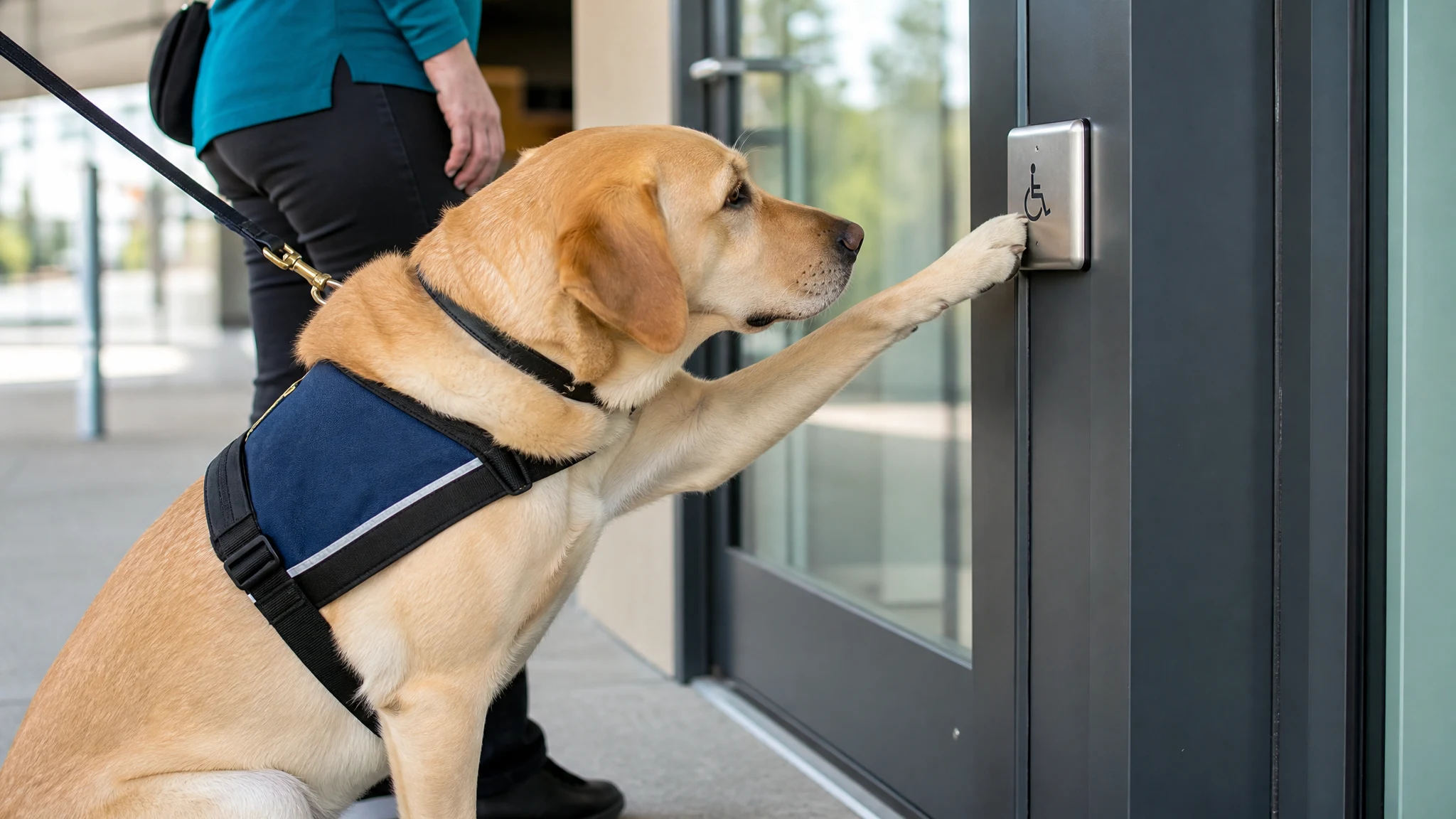
- Opening and closing doors or pressing an accessible door button.
- Providing counterbalance or bracing during a transfer or while standing.
- Pulling a manual wheelchair in some situations.
Hearing disabilities
- Alerting the handler to a doorbell, alarm, name being called or approaching sound.
- Leading the handler to the source of a sound.
Vision disabilities
- Guiding around obstacles.
- Stopping at curbs and stairs.
- Locating doors, elevators or an empty seat.
Seizure and medical conditions
- Staying with a person during a seizure and fetching help or a medical kit.
- Alerting to a change linked to a medical event, where a dog has been trained to do so.
- Reminding a person to take medication at set times.
Psychiatric and PTSD-related disabilities
- Interrupting repetitive or self-harming behavior.
- Waking the handler from nightmares.
- Turning on lights or checking a room on cue.
- Creating physical space in a crowd by positioning between the handler and others.
These are illustrations, not a checklist. A task has to fit the handler's own disability and be something the dog does on cue or in response to a trigger.
The public access test is a benchmark, not a legal requirement
Assistance Dogs International (ADI) is the organization behind a widely used public access standard for assistance dogs. Many programs and owner-trainers use a public access test like it to judge whether a dog is steady enough to work in public.
The ADA does not require a dog to pass a public access test, and ADA.gov does not require any certification or registration. Under the ADA, staff may ask only two questions when the disability or the task is not obvious:
- Is the dog a service animal required because of a disability?
- What work or task has the dog been trained to perform?
There is no official service dog registry, and an online registration or ID card is not legal proof of anything. This guide does not point you to any. For the exact content and scoring of ADI's test, check with ADI or a training program that uses it, since details can differ by program.
Even though the test is not a legal requirement, it is useful. A dog that works calmly in public is safer for the handler and easier to defend against any later complaint that the dog was out of control.
What you need
- A dog with a stable temperament and good health. Ask your own veterinarian about fitness for work.
- A flat collar or a well-fitted harness and a standard leash.
- Small, soft rewards your dog loves, plus the dog's regular meals to use as rewards.
- A notebook or phone log for recording each session, the task, the setting and the result.
- A written list of your disability-related needs, so tasks match real needs.
- Access to a variety of real places where you are permitted to practice.
- Patience. Reliable work usually takes many months of steady practice, and timelines vary.
Training stays humane and reward-based, in line with the American Veterinary Society of Animal Behavior (AVSAB). Do not use shock, prong or choke collars, alpha rolls, scruffing or dominance methods. They add stress and can damage the working relationship a service dog depends on.
Step-by-step: building tasks and preparing for the public access test
Step 1: Name the task and its purpose
Write one sentence that links the behavior to the disability. For example: "The dog retrieves dropped items because bending causes me pain and loss of balance." If you cannot write that sentence, the behavior may be a trick or a comfort, not a task.
Step 2: Build the foundation first
Teach the basics before any task: sit, down, stay, come, loose-leash walking and settling on a mat. Reward every correct repeat. Short sessions of five to ten minutes work better than one long one.
Step 3: Break the task into small pieces
Teach a retrieve, for example, in stages: look at the item, touch it, pick it up, hold it, bring it, then place it in your hand. Reward each stage before you combine them. Add a cue word only after the dog does the behavior reliably.
Step 4: Add a trigger, then distance and distraction
For alert tasks, pair the trigger (a sound, a scent or a signal from you) with the behavior and reward promptly. Then change one thing at a time: a new room, a longer distance or a mild distraction. If the dog fails, make the next step easier.
Step 5: Practice in real settings gradually
Move from quiet, familiar places to busier ones in small steps. Watch the dog's body language. If the dog is stressed, shaking or unable to take food, go back to an easier setting. Only enter places where you are legally allowed to practice, and check the Oklahoma section below about dogs in training.
Step 6: Practice the behaviors a public access test looks at
Public access tests generally look at whether the dog stays under control and focused on its handler. Practice these skills, and confirm the exact list with the program or organization whose test you plan to use:
- Walking beside you through crowds and tight spaces without pulling.
- Ignoring dropped food, other dogs and people who try to interact.
- Settling quietly under a table or chair for an extended time.
- Staying calm around carts, doors, elevators and loud noises.
- Not barking, sniffing merchandise or soliciting attention.
- Responding to cues the first time in a distracting place.
- Eliminating only on cue and in appropriate places.
Step 7: Run a mock test and record the results
Ask a patient friend to watch while you do a full practice outing. Note every slip: a sniff, a pull, a missed cue. Repeat the outing a week later and compare. Keep going until the dog works steadily across several different places and days, not just once.
Step 8: Decide if the dog is ready to work
Some dogs, even well-trained ones, are not suited to public work. Retiring a dog from public access, or switching it to home-only tasks, is a sound decision and not a failure.
Tips and common mistakes
- Training comfort and calling it a task. If the dog does nothing specific in response to your disability, the ADA definition is not met.
- Skipping the foundation. Task training on top of weak basics tends to fall apart in public.
- Rushing into busy places. Pushing a nervous dog too fast can build fear that is hard to undo.
- Treating a test as a finish line. Passing once does not mean the dog will work reliably forever. Keep practicing.
- Buying a vest, ID or registration and assuming it grants rights. The ADA does not require them, and they are not legal proof.
- Letting strangers pet or distract the dog. Politely decline. Every interaction can undo training.
- Training only in one place. Dogs do not always generalize. Practice each task in many settings.
- Not logging progress. Notes help you spot patterns and show how the dog was trained.
What Oklahoma law adds
Oklahoma has its own statutes alongside the ADA. This summary draws on a compilation of Oklahoma law from the Animal Legal and Historical Center at Michigan State University College of Law, so confirm the current statute text before relying on it.
- Public access. Under 7 O.S. 19.1, a blind, physically handicapped, deaf or hard-of-hearing person with a guide, signal or service dog may not be denied admittance or access to the listed public places because of the dog. The handler is liable for damage the dog does to the premises. A dog used by a deaf or hard-of-hearing person must wear an orange identifying collar.
- Broader federal coverage. The state definition in 7 O.S. 19.1 is narrower than the ADA. Handlers with disabilities not named there, including psychiatric disabilities, rely on the ADA.
- Dogs in training. 7 O.S. 19.1 gives access to dog trainers from a recognized training center who are in the act of training guide, signal or service dogs. The text read does not say whether owner-trainers have the same access, so check with the Oklahoma Attorney General's office before assuming they do.
- Housing. 25 O.S. 1452(A)(13) makes it unlawful to refuse to rent or lease housing to a blind, deaf or disabled person because of a bona fide, properly trained guide, signal or service dog.
- Misrepresentation. According to the Oklahoma House of Representatives, HB 1178 (2025) makes it a misdemeanor to pass off a non-service animal as a service animal, effective Nov. 1, 2025. The press release does not state the fine or jail terms.
- Interference. 21 O.S. 649.3 addresses harming or interfering with service animals.
For a broader look at the state's rules, programs and costs, see our guide to service dog training in Oklahoma, including laws, programs and costs.
Expected results
With steady, reward-based practice, many handlers find their dog becomes more reliable at tasks and calmer in public over several months. Results depend on the dog's temperament, the handler's consistency and the complexity of the tasks, so no outcome can be promised. Some dogs progress quickly. Others need more time or a different role.
A realistic goal is a dog that performs its trained tasks when needed and stays under control in public. That is also what ADA.gov expects of a working service dog.
If you are denied access
If a business turns you away in a way you believe violates the law, you may file a complaint with the Oklahoma Attorney General's Office of Civil Rights Enforcement (OCRE). OCRE takes public accommodation, housing and employment discrimination complaints. Public accommodation complaints must be filed within 180 days.
- Email: [email protected]
- Oklahoma City: (405) 521-3921
- Tulsa: (918) 581-2342
This article states the law in plain terms and is not legal advice. Check with the agency for your specific situation.
Sources
- ADA.gov, Frequently Asked Questions about Service Animals and the ADA
- Animal Legal and Historical Center, Consolidated Assistance Animal/Guide Dog Laws
- Oklahoma House of Representatives, Service Animal Protection Bill Becomes Law
- Oklahoma Attorney General, Office of Civil Rights Enforcement complaints page